
- Home
- »
- Beauty & Personal Care
- »
-
Probiotic Cosmetic Products Market Size Report, 2026-2033GVR Report cover
![Probiotic Cosmetic Products Market (2026 - 2033)Report]()
Probiotic Cosmetic Products Market (2026 - 2033)
Size, Share & Trends Analysis Report By Product (Skin Care, Hair Care), By Distribution Channel (Pharmacy & Drug Stores, E-commerce), By Region (North America, Europe, Asia Pacific, Latin America, MEA), And Segment Forecasts
Market Size, 2025
$341.8MMarket Estimate, 2026
$376.3MMarket Forecast, 2033
$946.4MCAGR, 2026–2033
14.1%Probiotic Cosmetic Products Market Summary
The global probiotic cosmetic products market size was valued at USD 341.8 million in 2025 and is projected to grow from USD 376.3 million in 2026 to USD 946.4 million by 2033, at a CAGR of 14.1% from 2026 to 2033. North America dominated the market with the largest revenue share of 34.0% in 2025. Increasing acceptance of probiotic products in dietary supplements has driven their applications in multiple areas, including skin care and cosmetics.

Key Market Trends & Insights
- By product: Skin care segment dominated the market, with a revenue share of 90.6% in 2025.
- By distribution channel: Hypermarket/supermarket segment held the largest market share of 39.5% in 2025.
Regional Highlights
- Largest regional market: North America (34.0% revenue share, 2025)
- Fastest-growing regional market: Asia Pacific (highest CAGR, 2026-2033)
- By country: The U.S. held the largest market share in 2025.
Market Size & Forecast
- Market size in 2025: USD 341.8 Million
- Estimated market size in 2026: USD 376.3 Million
- Projected market size by 2033: USD 946.4 Million
- CAGR (2026-2033): 14.1%
Three ways to get this report
Buy it, customize it, or ask a question.Ask an Analyst
A direct answer, usually in 1 working day
- AccessReport author, directly
- Reply timeWithin 1 working day
- No sales callDirect answer only
- FormatEmail reply
- CostFree, no cost
Get the Full Report
What the study covers
- FormatsPDF · Excel · Dashboard
- Timeline2026–2033 annual, 2025 base
- Coverage20+ countries, 5 regions
- Companies10+ key players profiled
Customize the Report
20% free customization
- IncludeCountries, segments, points
- TailorTo your product definition
- ExtendDeeper competitor detail
- OrA fully bespoke study
- Turnaround5–10 working days
Multiple companies have launched probiotic cosmetic products equipped with ingredients such as Lactobacillus, Bifidobacterium, and others. An increasing number of scientific discoveries and product innovations contribute to the growth of this market. In recent years, cosmeceuticals have been experiencing advancements in terms of formulations, ingredients used in making, and more. Increasing awareness and information regarding the microbiome, its significant role in maintaining and enhancing skin health, and growing research and development efforts associated with internal homeostasis, moisture retention, and others are expected to influence the growth of this market.
Enhanced availability facilitated by the growing penetration of online shopping portals, e-commerce websites, and quick commerce platforms has also assisted this market in terms of growth. Effective marketing, delivery of information-based content, education programs deployed by the manufacturers, and brand endorsements have added growth potential to this industry.
The increasing number of individuals seeking products that support personal care and wellness regimes and ease of availability and accessibility to information regarding advanced cosmetic products add growth opportunities for this market. New product launches, collaboration with celebrities and social media influencers, recommendations by skin health professionals, and a growing customer base of the men’s grooming industry have been fueling the growth of the probiotic cosmetic market.
The entry of established beauty and personal care brands in the market, attractive portfolios aligned with changing customer preferences, and growing acknowledgment experienced by the personalized skincare sector are expected to drive demand for this market in the coming years. Additionally, the inclination towards using natural or organic products instead of products formulated only with chemical substances and additives is likely to influence this market positively during the forecast period.
Market Dynamics
Probiotic cosmetic products are gaining significant traction as consumers increasingly seek skincare solutions that support the skin microbiome, improve barrier function, and promote overall skin health. These products incorporate probiotics, prebiotics, postbiotics, and microbiome-friendly ingredients to address concerns such as acne, sensitivity, dryness, redness, and premature aging. Growing awareness of preventive skincare, clean beauty trends, and scientifically backed cosmetic formulations is expected to continue driving growth in the probiotic cosmetic products market.
The increasing incidence of skin-related conditions such as acne, eczema, rosacea, dermatitis, skin sensitivity, and inflammation is significantly driving demand for probiotic cosmetic products. Factors including environmental pollution, UV exposure, stress, unhealthy lifestyles, hormonal fluctuations, and excessive use of harsh skincare products have disrupted the skin microbiome, leading to a growing need for microbiome-balancing solutions. Consumers are becoming more aware of the role beneficial microorganisms play in maintaining healthy skin, encouraging the adoption of probiotic-based skincare products. Additionally, rising demand for natural, non-invasive, and preventive skincare solutions is further supporting market growth, particularly among younger consumers and individuals with sensitive skin.
Limited consumer understanding regarding the efficacy and functionality of probiotic ingredients remains a key restraint for the probiotic cosmetic products market. Many consumers are still unfamiliar with microbiome-based skincare concepts, creating challenges for product adoption and brand differentiation. In addition, varying regulatory frameworks governing cosmetic claims, ingredient approvals, and product labeling across different countries can create compliance challenges for manufacturers. The lack of globally standardized regulations for probiotic cosmetic formulations may also lead to skepticism regarding product effectiveness, potentially limiting market expansion in certain regions.
Advancements in microbiome research, biotechnology, and personalized skincare are creating substantial growth opportunities in the probiotic cosmetic products market. Consumers are increasingly seeking customized skincare products tailored to their unique skin conditions, microbiome profiles, and lifestyle factors. Innovations in skin microbiome testing, AI-driven skincare recommendations, and targeted probiotic formulations are enabling brands to deliver more personalized beauty solutions. Furthermore, the growing popularity of clean-label cosmetics, sustainable ingredients, and science-backed skincare products is encouraging investment in probiotic and postbiotic technologies. These developments are expected to accelerate consumer adoption and expand the role of probiotic cosmetic products in modern skincare routines.
Analyst Perspective
The probiotic cosmetic products market is benefiting from strong consumer demand for microbiome-friendly skincare solutions, increasing awareness of skin health, and the growing preference for science-backed beauty products. The market is evolving beyond traditional skincare formulations toward products that support the skin’s natural microbiota, improve barrier function, and address concerns such as acne, sensitivity, dryness, and inflammation. The key competitive advantage will belong to companies that successfully combine clinically validated probiotic ingredients, product efficacy, clean-label formulations, and consumer education. As demand for personalized skincare, natural ingredients, and microbiome-based beauty solutions continues to expand, brands that invest in research, innovation, and product differentiation are expected to capture long-term market share and strengthen consumer trust.
Product Insights
Based on product, the skin care segment led the market with the largest revenue share of 90.6% in 2025 and is expected to grow at the fastest CAGR over the forecast period. This segment is mainly influenced by factors such as growing demand from young urban consumers, increasing product launches, and the entry of multiple established cosmetic brands in the category. Significant research and development activities in probiotic cosmetic products, investments in probiotic cosmetic pilots, and research by popular brands are expected to generate growth for this segment. Enhanced availability driven by improved offline distribution and the growing digital presence of brands also influence this segment.
The hair care segment is projected to experience the highest CAGR from 2026 to 2033. This is attributed to multiple aspects, such as the increasing focus of various cosmetics brands on research and development of new hair care formulations and the growing demand for men’s hair care products worldwide. In recent years, multiple brands have focused on aligning their product portfolios with customer expectations characterized by various trends such as demand for natural or organic products, affordability, ease of use, and more. Launching newly designed Probiotic hair care range products such as shampoos, conditioners, and others by major companies also contributes to growing demand.
Distribution Channel Insights
Based on distribution channel, the hypermarket/supermarket segment led the market with the largest revenue share of 39.5% in 2025. Distribution of novel products based on emerging technology or the latest scientific discoveries through supermarkets or hypermarkets is highly preferred by major market participants as it offers enhanced brand visibility and assists in customer education. The growing popularity of organized retail brands that operate chains of hypermarkets and supermarkets built across various regions worldwide adds to the growth of this market.

The e-commerce segment is anticipated to experience the fastest CAGR during the forecast period. This segment is primarily influenced by the ease of use and convenience offered by e-commerce websites and the increasing utilization of modern technology-assisted marketing strategies such as personalized advertisements. In recent years, e-commerce industry participants such as Amazon, Alibaba, Walmart, Flipkart, and others have embraced the latest technologies, such as artificial intelligence. The newly designed marketing strategies of e-commerce businesses leverage the availability of consumer data and deploy effective marketing campaigns. The quick availability of probiotic cosmetic products through e-commerce, return and refund options, and accessibility to detailed product information has attracted many customers.
Regional Insights
North America dominated the probiotic cosmetic product market with the largest revenue share of 34.0% in 2025. This market is primarily driven by factors such as the presence of multiple cosmetic industry participants in the region and growing demand from young urban users focused on embracing skin or hair wellness regimes. There has also been an increase in market penetration through the e-commerce industry.

U.S. Probiotic Cosmetic Products Market Trends
The probiotic cosmetic product market in the U.S. held the largest share in the North America region in 2025. This is attributed to a significant increase in research and development activities and the large number of companies exploring probiotic cosmetic product market opportunities. Established companies' investments in research, the availability of multiple products through online portals, and the growing acceptance of probiotic cosmetic products are expected to drive the growth of this market in the approaching years.
Europe Probiotic Cosmetic Products Market Trends
Europe probiotic cosmetic products market accounted for a significant revenue share in 2025. The presence of multiple cosmetic brands in the region significantly influences this market. Rising research activities by existing skin care manufacturers in the region and growing acceptance of probiotic ingredients are likely to generate a surge in growth for this market over the forecast period.
The probiotic cosmetic products market in Germany held the largest revenue share of the regional industry in 2025. This market is primarily influenced by increasing awareness regarding the benefits associated with the use of probiotic ingredients, growing demand for natural or organic products, and a significant increase in research activities focused on new product developments.
Asia Pacific Probiotic Cosmetic Products Market Trends
The Asia Pacific probiotic cosmetic products market is projected to experience the highest CAGR during the forecast period. This market is mainly driven by the growing focus of multiple cosmetic brands on emerging markets such as India and others. Growing demand from young consumers, increasing awareness regarding the significance of skincare and hair care in overall well-being, and significant growth experienced by companies entering the Asia Pacific market are also contributing to the growth of this regional industry.
The probiotic cosmetic products market in China held the largest revenue share of the regional industry in 2025. The growth of this market is primarily influenced by factors such as multiple production facilities in the country, the increasing focus of cosmetic brands on trials and research activities, and enhanced availability facilitated by online portals.
Key Probiotic Cosmetic Products Company Insights
Some of the key companies in the global probiotic cosmetic products industry are Esse Skincare, Estee Lauder Companies, Inc., Aurelia London (H&H Group), L’oreal S.A., and others. Growing demand and increasing acceptance for probiotic cosmetic products have stimulated multiple market participants to embrace strategies such as enhanced portfolios, improved research efforts, and collaboration with other companies.
-
Esse Skincare, one of the manufacturers in the microbiome skincare industry, offers a variety of products, including concealers, sensitive mists, protective oils, cleansers, D serum, cream cleansers, hyaluronic serum, repair oil, probiotic serums, intensity serums, more. Its probiotic cosmetic products range includes Esse Biome Mist, Esse Foundation, Esse Probiotic Serum, and others.
-
TULA Life, Inc., a company that specializes in probiotic skincare, offers a product portfolio characterized by solutions for multiple skin issues, such as acne and blemishes, aging, uneven tone, dark spots, dry skin, oily skin, sensitive skin, dull skin, and more. It also offers set and starter kits. Its products include cleansers, moisturizers, eye care, lip care, toners and face mists, body care, complexion, primers, sunscreens, masks, serums, and more.
Key Probiotic Cosmetic Products Companies:
The following key companies have been profiled for this study on the probiotic cosmetic products market.
-
Esse Skincare
-
Estee Lauder Companies, Inc.
-
Aurelia London (H&H Group)
-
L’oreal S.A.
-
TULA Life, Inc.
-
EMINENCE ORGANIC SKIN CARE
-
Unilever
-
LaFlore Probiotic Skincare
-
GLOWBIOTICS
-
The Clorox Company
Competitive Benchmarking
Category
Operating Strategies
Competitive Edge
Weakness
Established Players (L'Oréal S.A., Unilever PLC, The Estée Lauder Companies Inc., Amorepacific Corporation, Johnson & Johnson, Shiseido Company, Limited)
- Expand probiotic-based skincare portfolios through R&D investments, strategic acquisitions, and partnerships with biotechnology firms. Focus on premium product positioning, clinical validation, and global distribution expansion across retail and e-commerce channels.
- Strong brand equity, extensive distribution networks, substantial R&D capabilities, and large marketing budgets. Ability to conduct clinical studies and leverage consumer trust to accelerate adoption of probiotic cosmetic products.
- Higher product development and regulatory compliance costs. Longer product innovation cycles due to extensive testing and approval processes. Difficulty in rapidly adapting to niche consumer trends and increasing competition from agile indie beauty brands specializing in microbiome-focused skincare.
Emerging Players (Gallinée, Mother Dirt, Aurelia London, Esse Skincare, Codex Beauty, TULA Skincare)
- Focus on microbiome-friendly and probiotic-focused formulations targeting specific skin concerns. Utilize direct-to-consumer sales, influencer marketing, social media engagement, and clean beauty positioning to build brand awareness.
- Faster innovation cycles, strong appeal among health-conscious and clean beauty consumers, and ability to quickly respond to emerging skincare trends. Specialized expertise in microbiome science helps differentiate products in a competitive market.
- Limited financial resources and smaller marketing budgets compared to multinational brands. Lower consumer awareness and trust in certain markets. Dependence on niche customer segments and challenges in scaling distribution, clinical validation, and international expansion profitably.
Recent Developments
-
In September 2024, Unilever introduced the POND’S SKIN INSTITUTE Microbiome Analyzer, a new technology that provides personalized skincare recommendations based on an individual’s skin microbiome analysis, completed within 60 minutes. This innovation responds to the increasing consumer demand for science-based skincare solutions and utilizes Unilever’s expertise in microbiome science to generate tailored product suggestions. The Microbiome Analyzer was piloted in partnership with Watsons in the Philippines, highlighting the company’s commitment to advancing skincare technology and meeting evolving consumer needs.
-
In December 2023, L'Oréal announced the acquisition of Lactobio, a Danish company specializing in precision probiotics and microbiome research. This strategic move aims to enhance L'Oréal's expertise in microbiome science, enabling the development of innovative cosmetic solutions that incorporate live bacteria for improved skin and hair benefits. The integration of Lactobio's advanced formulations with L'Oréal's technological capabilities is expected to accelerate the creation of new beauty products based on scientific research.
Probiotic Cosmetic Products Market Report Scope
Report Attribute
Details
Market size in 2025
USD 341.8 million
Estimated market size in 2026
USD 376.3 million
Projected market size by 2033
USD 946.4 million
Growth rate
CAGR of 14.1% from 2026 to 2033
Base year for estimation
2025
Historical data
2021 - 2024
Forecast period
2026 - 2033
Quantitative units
Revenue in USD million/billion and CAGR from 2026 to 2033
Report coverage
Revenue forecast, company ranking, competitive landscape, growth factors, and trends
Segments covered
Product, distribution channel, region
Regional scope
North America; Europe; Asia Pacific; Latin America; MEA
Country scope
U.S.; Canada; Mexico; Germany; UK; France; Italy; Spain; Rest of Europe; China; Japan; India; South Korea; Australia; Rest of Asia Pacific; Brazil; UAE
Key companies profiled
Esse Skincare; Estee Lauder Companies, Inc.; Aurelia London (H&H Group); L’oreal S.A.; TULA Life, Inc.; EMINENCE ORGANIC SKIN CARE; Unilever; LaFlore Probiotic Skincare; GLOWBIOTICS; The Clorox Company
Customization scope
Free report customization (equivalent up to 8 analysts' working days) with purchase. Addition or alteration to country, regional & segment scope.
Pricing and purchase options
Avail customized purchase options to meet your exact research needs. Explore purchase options
Global Probiotic Cosmetic Products Market Report Segmentation
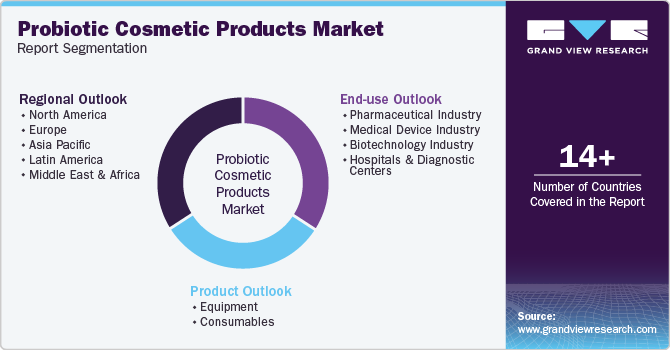
This report forecasts revenue growth at global, regional, and country levels and provides an analysis of the latest industry trends in each of the sub-segments from 2021 to 2033. For this study, grand view research has segmented the global probiotic cosmetic products industry report based on product, distribution channel and region.
-
Product Outlook (Revenue, USD Million, 2021 - 2033)
-
Skin Care
-
Hair Care
-
-
Distribution Channel Outlook (Revenue, USD Million, 2021 - 2033)
-
Hypermarket/Supermarket
-
Pharmacy and Drug Stores
-
E-commerce
-
Others
-
-
Regional Outlook (Revenue, USD Million, 2021 - 2033)
-
North America
-
U.S.
-
Canada
-
Mexico
-
-
Europe
-
Germany
-
France
-
United Kingdom
-
Italy
-
Spain
-
-
Asia Pacific
-
China
-
India
-
Japan
-
Australia
-
South Korea
-
-
Latin America
-
Brazil
-
-
Middle East
-
UAE
-
-
Research Methodology
Segment Definition
Segment - Product
Revenue capture definition
Skin Care
This segment covers the revenues generated through the sales of probiotic cosmetic skincare products designed to support the skin microbiome, improve skin barrier function, and address concerns such as acne, dryness, sensitivity, redness, and aging. Examples: Probiotic facial creams, moisturizers, serums, cleansers, toners, face masks, and anti-aging formulations.
Hair Care
This segment covers the revenues generated through the sales of probiotic cosmetic hair care products formulated to maintain scalp health, balance the scalp microbiome, and improve hair quality. These products help address concerns such as dandruff, scalp irritation, dryness, and hair weakening. Examples: Probiotic shampoos, conditioners, scalp serums, hair masks, and scalp treatment products.
Segment - Distribution Channel
Revenue capture definition
Hypermarket/Supermarket
This segment covers the revenues generated through the sales of probiotic cosmetic products via hypermarkets and supermarkets. These retail outlets offer a wide range of skincare and personal care products, enabling consumers to compare brands and make convenient purchases. Examples: Walmart, Carrefour, Tesco, Target, Reliance Smart, and Big Bazaar.
Pharmacy and Drug stores
This segment covers the revenues generated through the sales of probiotic cosmetic products through pharmacies and drug stores, where consumers often seek dermatologist-recommended and clinically formulated skincare products. Examples: CVS Pharmacy, Walgreens, Boots, Apollo Pharmacy, and MedPlus.
E-commerce
This segment covers the revenues generated through the sales of probiotic cosmetic products through online retail platforms and digital marketplaces. These channels provide easy access to a broad product range, customer reviews, and direct-to-consumer offerings. Examples: Amazon, Nykaa, Flipkart, Sephora Online, and brand-owned websites.
Others
This segment covers the revenues generated through the sales of probiotic cosmetic products via alternative distribution channels such as specialty beauty stores, department stores, salons, spas, and direct selling networks. Examples: Sephora stores, Ulta Beauty, beauty clinics, professional salons, and wellness centers.
Estimation Model
Layer Title
Guiding Question
Description
Epidemiology Layer
Who has a relevant skincare or haircare need?
Identify consumers experiencing concerns such as acne, sensitive skin, eczema, inflammation, barrier repair needs, aging skin, and scalp health concerns. Growing awareness of skin microbiome health and demand for science-backed products forms the core consumer pool.
Digital Access Layer
Who can be reached through cosmetic distribution channels?
Apply beauty product penetration rates, disposable income levels, premium skincare adoption, and access through pharmacies, specialty beauty stores, supermarkets, and e-commerce platforms to estimate the addressable market.
Behavioural Layer
Who actively purchases probiotic cosmetic products?
Apply adoption rates for microbiome-based skincare and haircare products. Convert reachable consumers into active buyers based on awareness of probiotics, clean-label preferences, dermatologist recommendations, and demand for natural, science-backed formulations.
Monetisation Layer
How much revenue is generated?
Multiply active buyers by annual purchase frequency and average selling price (ASP) across probiotic skincare creams, serums, masks, cleansers, and haircare products. Include revenue projected through both offline retail and online channels.
Delivered Customizations
This report has been delivered with the following In-depth customizations
Client Request
Customization Delivered
Value Adds
Probiotic Skincare & Beauty Product Trends
Conducted a focused analysis of probiotic cosmetic products covering microbiome-friendly skincare, probiotic and postbiotic formulations, anti-aging solutions, acne care, sensitive skin applications, and clean beauty trends.
Helps stakeholders identify high-growth product categories, evaluate consumer preferences for skin health-focused cosmetics, and assess innovation opportunities in microbiome-based beauty solutions.
Consumer Wellness & Natural Beauty Adoption Trends
Evaluated adoption trends for natural and science-backed skincare products, clean-label cosmetics, personalized beauty solutions, e-commerce purchasing behavior, and premium skincare demand.
Provides insights into evolving consumer expectations, emerging beauty and wellness trends, and commercially attractive segments to support product development and brand positioning strategies.
Microbiome Beauty Market Infrastructure & Opportunity Assessment
Assessed demand for probiotic cosmetic products across skincare, haircare, and personal care applications, including regulatory considerations, ingredient innovation, sustainability initiatives, and distribution channel dynamics.
Supports investment and expansion strategies by identifying underserved market opportunities, evaluating technology and formulation advancements, and strengthening long-term growth potential within the microbiome beauty industry.
Frequently Asked Questions About This Report
Some key players operating in the probiotic cosmetic products market include ESSE SKINCARE, Estee Lauder Companies, Inc., Aurelia Skincare Ltd., L’Oreal S.A., Tula Life, Inc., EMINENCE ORGANIC SKINCARE, LaFlore Probiotic Skincare, GLOWBIOTICS Inc., Unilever, and The Clorox Co.
Key factors that are driving the probiotic cosmetic products market growth include growing awareness about probiotics as a beneficial element and concerns regarding skin problems such as acne, damaged skin.
Asia Pacific is the fastest growing region over the forecast period.
Skin care segment led the market with the largest revenue share of 90.6% in 2025 while hair care segment is expected to be the fastest-growing market.
Hypermarket/supermarket segment led the market with the largest revenue share of 39.5% in 2025 while e-commerce segment is expected to be the fastest-growing market.
North America dominated with a 34.0% revenue share in 2025.
The global probiotic cosmetic products market is expected to grow at a CAGR of14.1% from 2026 to 2033, reaching USD 946.4 million by 2033.
The global probiotic cosmetic products market size was valued at USD 341.8 million in 2025 and is estimated at USD 376.3 million in 2026.
About the Author(s)
Beauty & Personal Care Research Team
Consumer Goods · Beauty & Personal CareThis report was authored by the beauty & personal care research team at Grand View Research - comprising two research analysts, one senior research analyst, and one industry expert - with specialized expertise in the beauty & personal care segment of the consumer goods industry. All findings are based on proprietary consumer goods databases, executive interviews, and regulatory analysis, subject to internal peer review prior to publication.
Last Updated:
Speak to Analyst


Customize this report to your needs - add regions, segments, or data points, with 20% free customization.
Or view our licence options:


ISO 9001:2015 & 27001:2022 Certified
We are GDPR and CCPA compliant! Your transaction & personal information is safe and secure. For more details, please read our privacy policy.


